

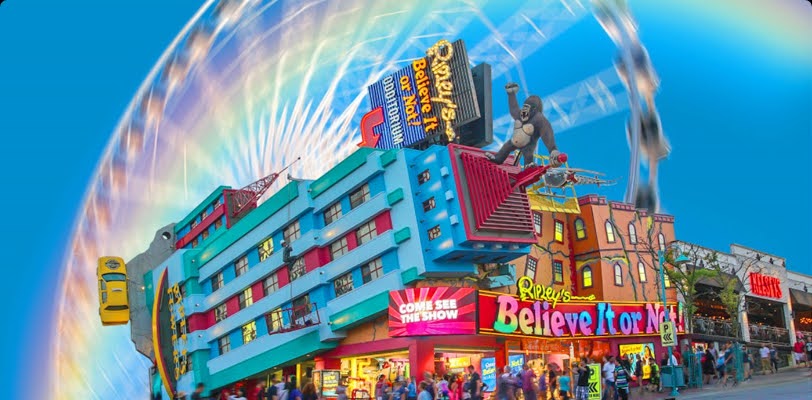
Clifton Hill, Niagara Falls
This article has multiple issues. Please help improve it or discuss these issues on the talk page.
Clifton Hill is one of the major tourist promenades in Niagara Falls, Ontario. The street, close to Niagara Falls and the Niagara River, leads from River Road on the Niagara Parkway to intersect with Victoria Avenue, and contains a number of gift shops, wax museums, haunted houses, video arcades, restaurants, hotels and themed attractions. It is a major amusement area and centre for night life, particularly for families and teenagers.
View of Clifton Hill from the Skylon Tower in 2023
Burger King restaurant, Ripley’s Moving Theatre, and the House of Frankenstein in Clifton Hill, 2021
Properties on Clifton Hill are bought, sold and renamed frequently. The street is dominated by two primary property owners: the Harry Oakes Company (HOCO) and the Niagara Clifton Group.[1]
Comfort Inn, also part of Clifton Hill, closed in 2015 and was later demolished as part of a major development that included the Niagara Speedway go-kart track, an extension of the Great Canadian Midway video arcade, a zombie-themed 4D ride, multiple snack stands, and a Ripley’s Believe It or Not! Museum expansion. The expansion began in early 2016 and was completed in the summer of 2018.[2]
History
edit
Early history
edit
Darling Cabins and Hotel Bettina
The land now occupied by Clifton Hill was acquired by the Phillip Bender family in 1782, as part of a United Empire Loyalist land grant. In 1832 the property was purchased by British Army officer Captain Ogden Creighton, a half-pay officer who had served in the 70th and 81st Regiments. Creighton laid out streets and building lots on the land, naming the future settlement Clifton, presumably after Clifton on the gorge of the River Avon in Bristol, England. Creighton built his residence, Clifton Cottage, on the edge of a high bank facing the American Falls, on the site of the present-day Quality Inn.
Creighton was involved in suppressing the Rebellion of 1837. Following a clash between William Lyon Mackenzie and an Upper Canada government militia north of Toronto, the rebel leader took his forces to Navy Island on the Niagara River to form a provisional government. In mid-January 1838, Mackenzie and his followers evacuated the island. At the time Clifton Cottage became the headquarters for a military detachment which was assigned to guard the border ferry. The Creighton family left the Niagara area in the early 1840s, moving to Toronto and later Brantford, Ontario. Creighton died around 1850.
The street now called Clifton Hill was previously known as Ferry Road, named due to its proximity to the rowboat transportation system that ferried people across the Niagara River between Canada and the United States prior to the completion of the Niagara Falls Suspension Bridge. Ferry Road provided access to the Niagara Gorge where the boats docked.
In 1833 the first Clifton Hotel was built at the base of the street by Harmanus Crysler. Following in 1842, financier Samuel Zimmerman created a 52-acre (210,000 m2) estate property along the south side of the road. Dubbed Clifton Place, Zimmerman planned to create many gardens, large fountains and a mansion that was to be his residence. The estate occupied the entire south side of what is now Clifton Hill, bounded by the Niagara River, Murray Hill and Ferry Road. Among the buildings constructed were four large gatehouses (the last was completed in 1856) and a $18,000 stable constructed of imported English yellow brick. In addition a fountain was created in the centre of the property.
Zimmerman was killed on March 12, 1857, in the Desjardins Canal railway accident. He only lived to see the foundations of his $175,000 “Clifton Place” mansion built. Only the fountain remains to this day, located at the northern end of Queen Victoria Park.
The Zimmerman estate was taken over by the Bank of Upper Canada, which went bankrupt in 1866. The estate was put up for sale and purchased by State Senator John T. Bush of Buffalo, New York for 25 cents on the dollar. Bush acquired Clifton House, the adjoining properties, and went on to complete the lavish Clifton Place mansion. Bush and his family lived in the building for the next 50 years, with his daughter Josephine residing there until 1927. In 1928 the Bush estate was sold to Harry Oakes of Welland Securities.
The first Clifton Hotel was destroyed by fire in 1898, and the ruins laid untouched until 1905, when the second Clifton House and Lafayette Hotel was built. Another fire broke out at the Clifton on December 31, 1932, and was again a total loss.
Harry Oakes bought this property and deeded it to the Niagara Parks Commission, which built Oakes Garden Theatre, opening in September 1937.
Clifton Hill as a tourist destination
edit
October 1973
The 1920s saw considerable growth in the area as a tourist destination. In 1925 Howard Fox opened the Foxhead Inn on Clifton Hill at Falls Avenue. On the north side of the hill the Niagara Falls Tourist Camp was opened by Charles Burland. Earl McIntosh opened two campgrounds, the Clifton Touring Camp on the south side of the street and Clifton Camp to the north. Reinhart’s Riverhurst Inn was built between the Niagara Falls Tourist Camp and the Foxhead Inn.
In the 1950s the land on the south side of the street was offered to the Government of the United States as a site for a new American Consulate (Niagara was home to US Consul from 1899 to 1959), but the offer was never taken up, and the land was later sold. Two hotels opened in the 1950s that are still in operation today: the Park Motor Hotel and the Quality Inn Fallsway Hotel.
Beginning in the 1960s, Clifton Hill began to see various museums built, including the Houdini Hall of Fame, Ripley’s Believe It or Not!, Louis Tussaud’s Waxworks, House of Frankenstein, and the Guinness World Records museum.
Attractions
In popular culture
References
External links
Last edited 4 months ago by NJZombie
Related articles
Wax museum
Museum displaying a collection of wax representations of famous people
Louis Tussaud
English wax museum founder
Sheraton Fallsview Hotel
Canadian resort hotel
Wikipedia
Wikimedia Foundation
Powered by MediaWiki
Content is available under CC BY-SA 4.0 unless otherwise noted.
Privacy policy Contact Wikipedia Legal & safety contacts Code of Conduct Developers Statistics Cookie statement Terms of Use Desktop view

No comment